

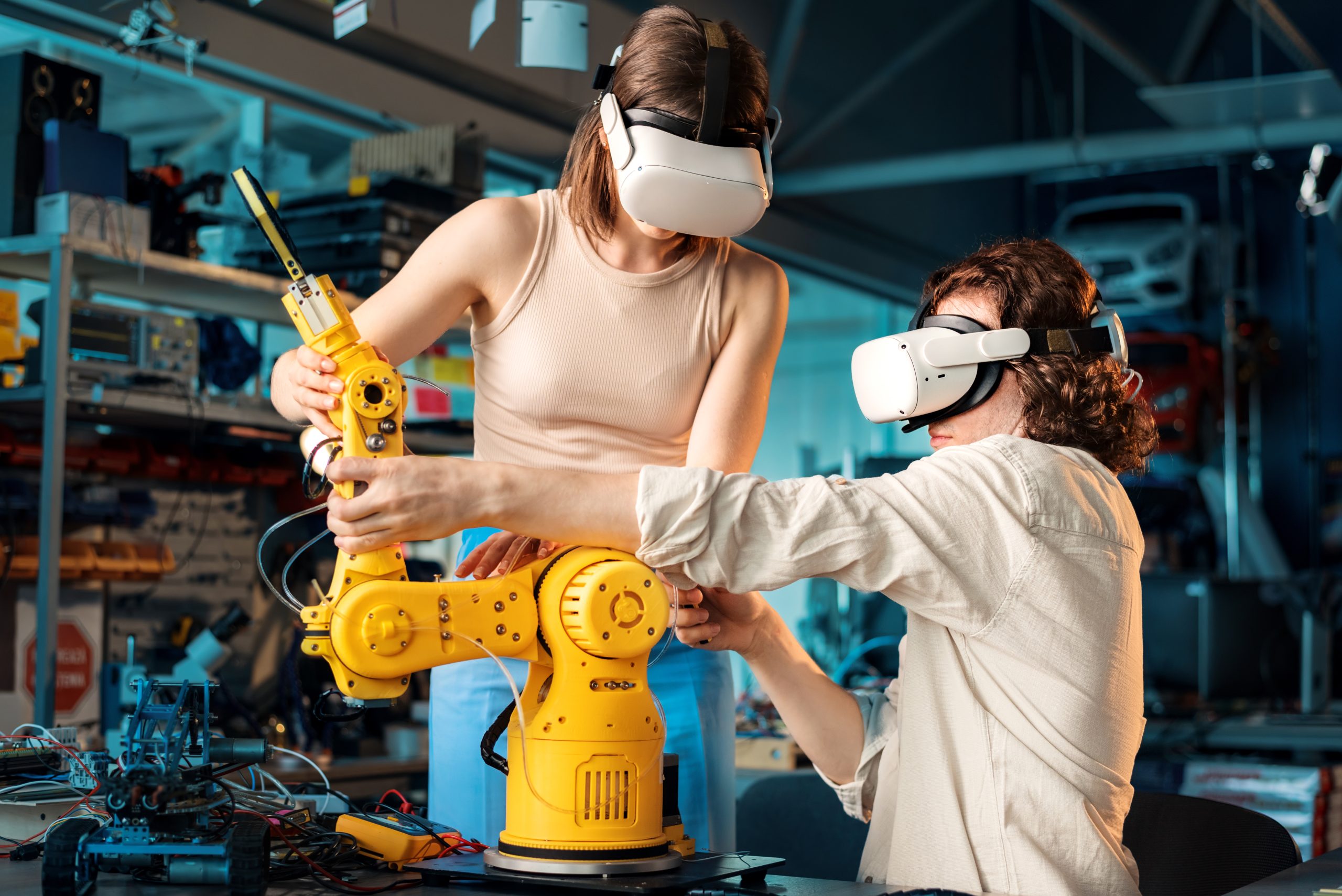
After years of development, intelligent machines are reshaping labour, productivity, and the boundaries of human capability.
The transformation is neither catastrophic nor utopian—it is structural.
AI becomes a collaborative partner
AI systems no longer operate as tools that execute narrow tasks. Increasingly, they function as collaborative agents capable of assisting in reasoning, pattern recognition and coordination.
Financial firms use AI for risk modelling; hospitals use it for triage and radiology; universities rely on it for research acceleration.
Platforms built by OpenAI and other labs provide the foundation for large-scale cognitive automation.
AI’s role is not to replace human judgement but to extend it.
Robotics expands into essential labour
Robotic deployment is accelerating in sectors facing chronic labour shortages: agriculture, logistics, construction and elderly care.
Advanced robots developed by companies such as Boston Dynamics and Fanuc are equipped with dexterity, autonomy and real-world adaptability.
In agriculture, robots monitor crops, apply precision treatments and harvest produce.
In hospitals, automated systems transport supplies, assist with rehabilitation and manage sanitation.
Robots are no longer confined to factories—they are becoming essential components of public infrastructure.
The evolution of human skills
As intelligent machines take over repetitive, hazardous and computationally intensive tasks, human labour shifts toward roles that require abstraction, emotional intelligence, strategic oversight and ethical decision-making.
This transition is redefining skill hierarchies.
Technical literacy is becoming foundational; creative and interpersonal capabilities are gaining value.
Education systems in countries such as Finland and Canada are adapting curricula to prepare students for hybrid human–machine environments.
Ethics and governance become central
With machines increasingly influencing decisions, governments and regulatory bodies face new questions about transparency, accountability and safety.
The European Commission continues to shape global standards through AI governance frameworks that prioritise privacy, fairness and explainability.
The challenge is balancing innovation with social protection.
A new model of human–machine coexistence
The direction of technological change is clear: AI and robotics will become pervasive components of workplace and civic life. The next decade will determine whether societies integrate these systems equitably and sustainably.
Technology is no longer expanding human capability at the margins—it is redefining the foundations of work, mobility and decision-making.
