

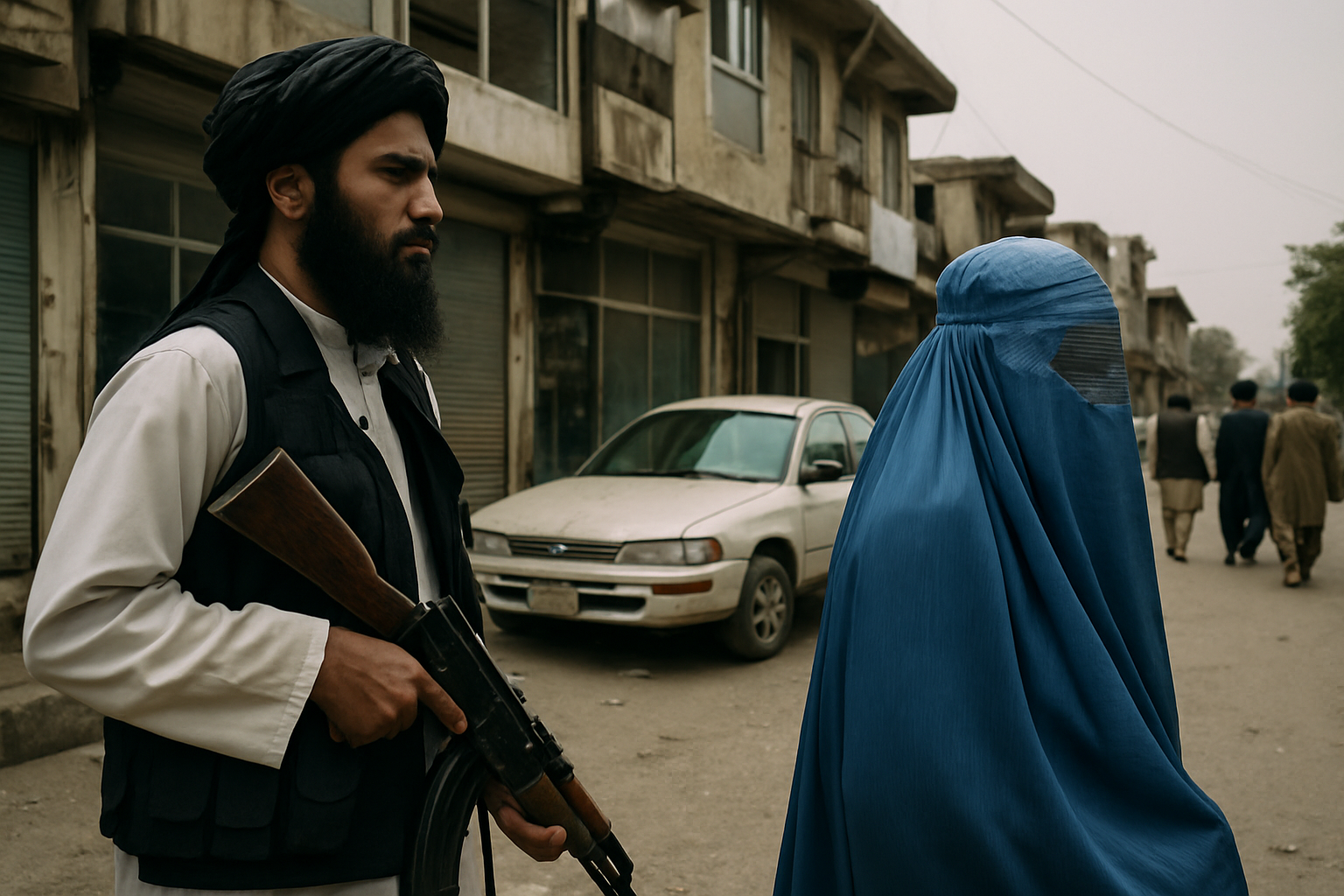
A BBC report based on access to senior Taliban figures and residents of Afghanistan has documented the group’s approach to government, including severe restrictions on women, media controls and persistent economic hardship.
In Sheberghan, northern Afghanistan, Jawzjan governor Abdullah Sarhadi heard the case of an 18-year-old woman seeking a divorce from a husband she accused of abuse and beatings. The woman, identified as Tuba, told the governor that she had decided to end the marriage. Sarhadi encouraged her to remain with her husband and said officials would warn him against further violence. Her father later said the family would take the case to court, despite the difficulty women face in obtaining a divorce without a husband’s consent under the Taliban court system.
Sarhadi, a former Taliban military commander who was detained for several years at Guantanamo Bay after the group’s first government was removed in 2001, also described a recent ban on smartphones for officials as slowing administrative work. He later acknowledged that he had personally helped destroy one of the ancient Buddha statues in Bamiyan during the Taliban’s earlier period in power, saying the action followed what he considered religious guidance.
Education and speech restrictions
The BBC also met Habibullah Badr, who said he had previously been responsible for Taliban suicide attack operations in Kabul. He was later deputy head of prisons nationally and had run the prison where he had once been held under the previous government. Badr declined to discuss specific attacks in civilian areas, saying such conversations could upset people and reopen wounds.
At a gathering attended by Badr, charity foundation head Sultan Mohammad Talaee called for schools and education to be reopened to everyone, including girls. His microphone was removed after his remarks. He later told the BBC that education was an Islamic obligation for both men and women. The report said women described despair over blocked educational ambitions, while some said friends had been jailed after protesting. Most journalists interviewed said they had been summoned or questioned by the Taliban intelligence organisation, Estikhbaraat.
Taliban government spokesman Zabihullah Mujahid told the BBC that women’s rights, freedom of speech and other issues should be assessed within a Sharia framework. He said allowing women to work in offices such as his could lead to what he described as immoralities and undermine their dignity. Mujahid said women’s education remained under discussion and required a Sharia-based solution. On media restrictions, he said outlets could not broadcast material against Islamic laws and rites.
In Kandahar, where the Taliban’s supreme leader Hibatullah Akhundzada is based, the BBC reported tighter controls than during a visit two years earlier. Men were required to have beards, radio stations could not play music or air women’s voices, and filming in the city was prohibited. The BBC was told a meeting with Akhundzada, who rarely appears publicly and has never given a media interview, was not possible.
Former fighters in a rural area near Kandahar showed the BBC caves used by Taliban insurgents before their return to power. They said their communities needed water, roads and clinics. The United Nations, cited by the BBC, says three in four people in Afghanistan cannot meet their basic needs. Taliban figures said they were working on economic problems, while some residents said they believed the group’s rule was the country’s central problem.
Source: BBC News
