

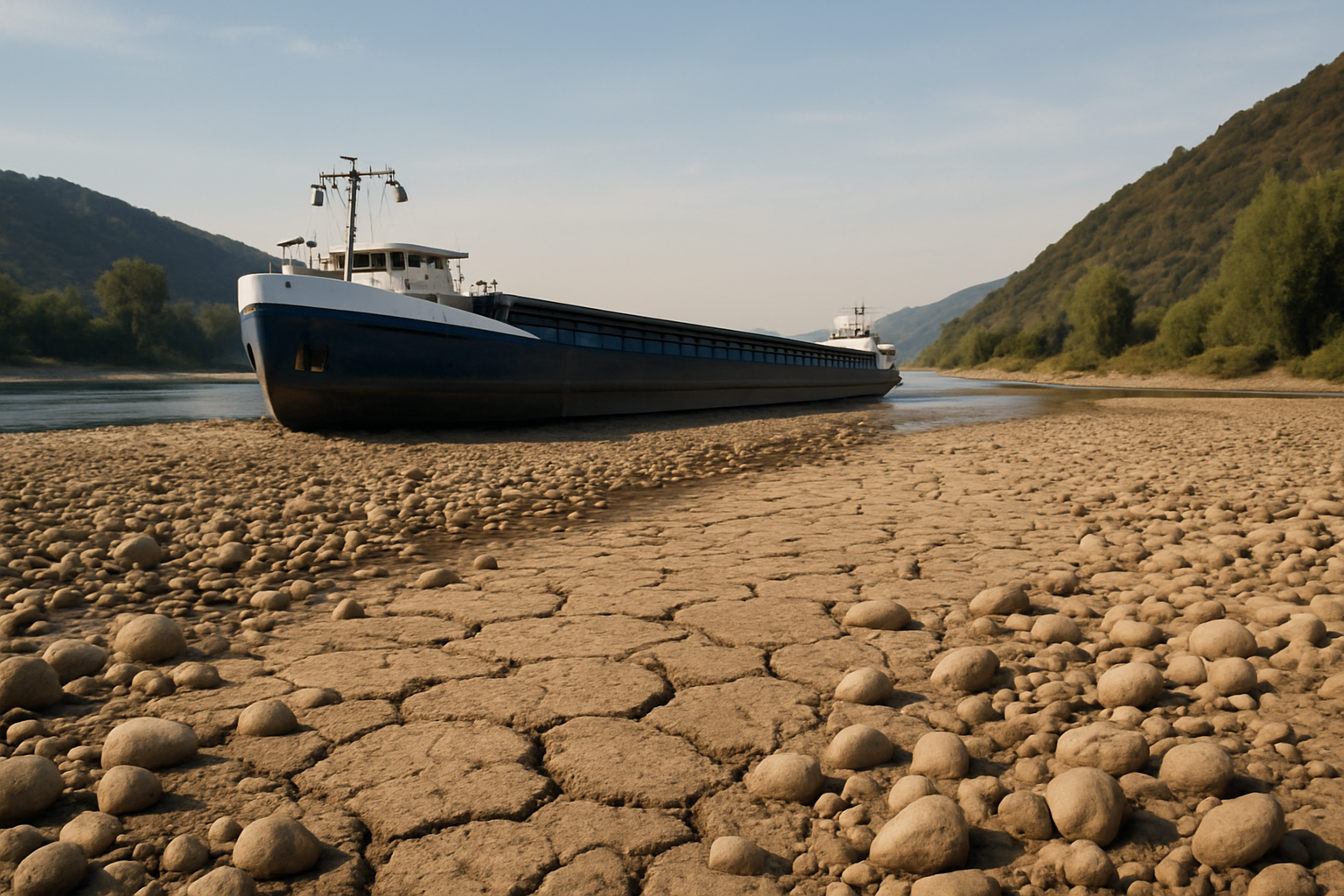
Water levels on the Rhine have reached record lows at several points in Germany and the Netherlands as prolonged heatwave conditions and drought affect major rivers across Europe.
Measurements taken last week in Cologne, western Germany, and Lobith, near the German-Dutch border, were lower than any previously recorded at those locations. The Rhine is one of Europe’s most heavily used waterways, running from the Swiss Alps to the North Sea, and its declining depth has raised concern over the movement of goods.
Germany’s Low Water Information System reported that, by the end of July, 44% of Rhine monitoring stations had registered extremely low water levels. On the Danube, the figure was 78% of stations.
Shipping restrictions and higher costs
At Kaub, a key Rhine bottleneck near Koblenz in western Germany, navigable depth fell to 25cm on Friday, matching the low recorded in 2018. The level recovered slightly by Monday, but the gauge remains an important measure of how much cargo river vessels can safely carry.
Martin Wolters of the Rhine Waterways and Shipping Authority told WDR that a complete halt to Rhine shipping was not expected. However, operators may need to distribute cargo among more vessels to reduce their weight. He said such measures could raise transport costs and contribute to supply bottlenecks over time.
A commodity trader told Reuters that shipping can become commercially unviable when vessel loads are reduced too far, while owners may also become concerned about damage to their ships.
Energy and agriculture under pressure
The Danube has also reached its lowest levels in 30 years in several countries, including Serbia and Romania. Hungary’s only nuclear power plant has been operating at reduced capacity and is being monitored for the possibility that it may have to be shut down.
In Serbia, low water levels have disrupted cooling systems and led to reduced output at coal-fired power plants. Romania carried out a controlled explosion on a large rock along the Danube to improve water flow towards the Cernavoda nuclear power plant. Romanian carmakers Dacia and Ford agreed to suspend production for more than two weeks in an effort to lower electricity use.
Italy’s Po, the country’s longest river, reached a historic low near Cremona in late July. Authorities placed the entire Po Valley under a high drought alert. Experts have warned of possible disruption to drinking-water supplies, while reduced river flow at the Po’s mouth has allowed seawater to move into the riverbed, affecting ecosystems and farmers who rely on the water for irrigation.
The EU’s Drought Observatories said conditions were stable at critical levels across much of Europe and had deteriorated in central-western areas by mid-July. Further heatwave conditions were forecast to continue for at least another week, with temperatures expected to exceed 40C in many central and southern European countries.
Scientists from World Weather Attribution said there was no clear long-term trend towards lower rainfall across much of Europe. However, they said higher temperatures linked to human-caused climate change were increasing evaporation, making drought conditions more likely. Hot and dry weather has also increased demand for water from households, agriculture and industry.
Source: BBC News
