

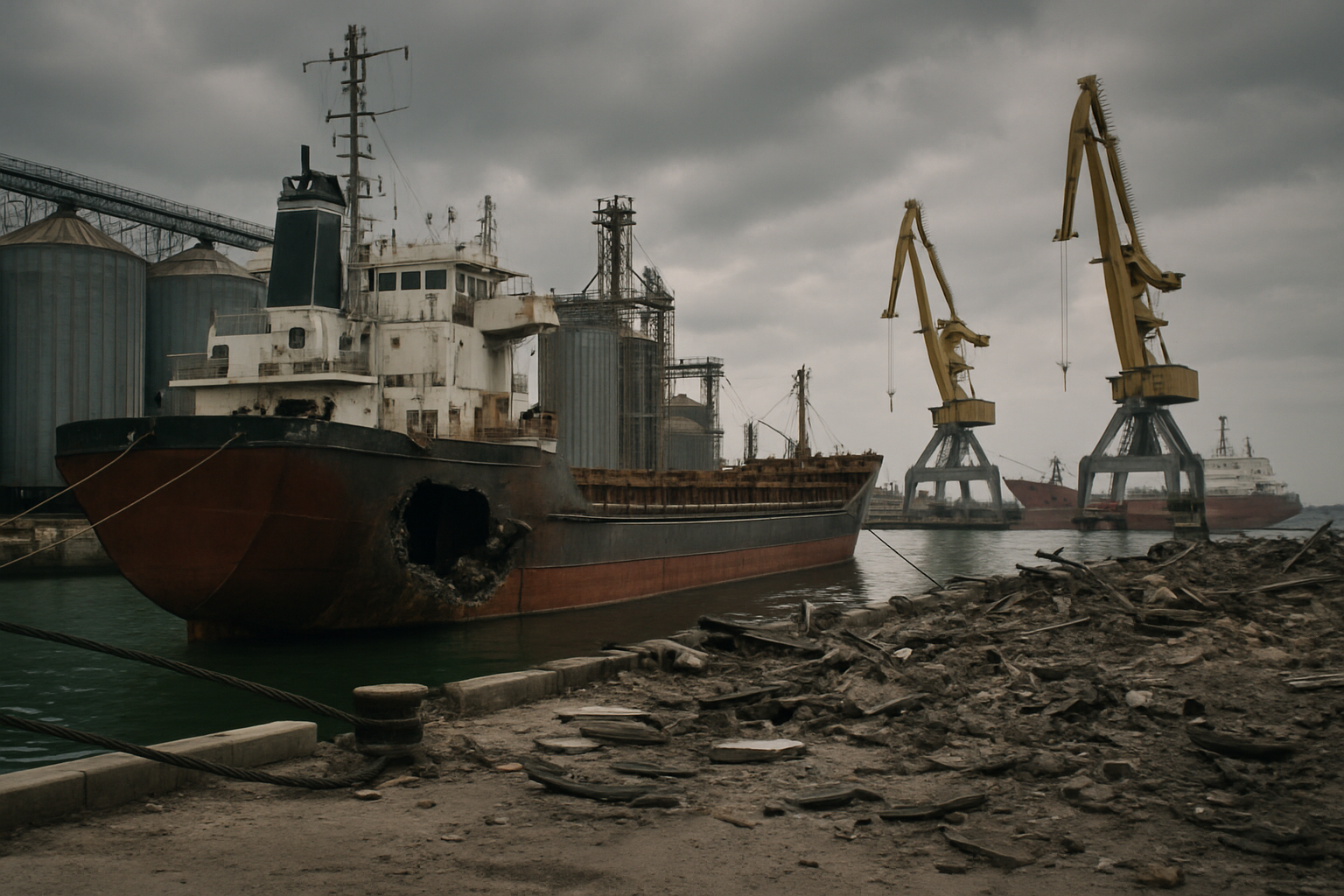
Russian missile and drone attacks on Ukraine’s Black Sea coastline have intensified in recent weeks, damaging port facilities, striking civilian vessels and leaving major ports around Odesa with little commercial activity, according to Ukrainian officials and port industry representatives.
At Odesa’s main port, warehouse shift manager Svitlana Halchenko said a Russian ballistic missile strike killed two colleagues near her. Halchenko, who still has shrapnel injuries to her leg and back, has returned to work, but described an increasingly tense atmosphere marked by frequent air-raid alerts, drone attacks and strikes.
Ukraine’s port administration said Russia carried out 57 attacks on civilian vessels in July, including 22 at sea, as well as 67 strikes on port infrastructure. The recent attacks have affected the approaches to Odesa, Chornomorsk and Pivdennyi, where ships that once queued for berths are now largely absent.
Threats to crews and port workers
On July 19, the Turkish-owned cargo ship Golden Leo, carrying Ukrainian corn, was hit by three Russian missiles, according to the report. Nine Indian and Syrian crew members and a Ukrainian pilot were killed. The vessel sank off Odesa a week later.
Lloyd’s List, a global shipping publication, said the Black Sea may now be the world’s most dangerous shipping area. It described July as the deadliest month for merchant seafarers since Russia began its full-scale invasion of Ukraine.
Oleg Grygoriuk, chairman of the Marine Transport Workers Union of Ukraine, said some port employees consider their work more frightening than frontline service. He said missiles launched from Crimea can reach Odesa in about a minute, while workers in cranes may need more than three minutes to reach a shelter.
During a tightly controlled visit to a major port in the Odesa area, damaged cargo vessels were visible near empty berths and idle cranes. A senior port manager, who was not named for security reasons, said the facility had recently been forced to halt operations for 15 hours of a 24-hour period because of alerts. Although the ports remain formally open, the danger has discouraged many shipowners from calling there.
Grain exports under pressure
Andrey Stavnitser, co-owner and chief executive of one of the area’s largest ports, said the supply chain was effectively on hold because of the danger to crews. He said Russia’s actions were likely retaliation for Ukrainian attacks on Russian shipping, including sanctioned oil vessels and ships used to carry supplies to Russian-occupied Crimea.
Ukraine has used drones in Operation MoLoChKa, which the report said has struck about 200 Russian vessels and brought traffic in the Sea of Azov close to a standstill. Ukrainian representatives argue that their actions seek to weaken Russia’s control of occupied territory, while Russian attacks are restricting Ukraine’s ability to export grain.
The disruption comes as Ukraine’s summer grain harvest is under way. Volodymyr Slavinskyi, trading director at grain exporter Nibulon, said farmers need to sell harvested crops quickly and reinvest in the next production cycle. He estimated that Ukraine had already lost the ability to supply between 500,000 and 700,000 metric tonnes of grain and oilseeds to global customers.
Before the full-scale invasion, Ukraine accounted for about 6% of global wheat exports and 10% of corn exports. The Greater Odesa ports handled more than 73 million tonnes of Ukraine’s maritime exports last year, including 38 million tonnes of grain. The continuing attacks have also affected people living near port areas, including residents whose homes have been damaged by drone explosions.
Source: BBC News
