

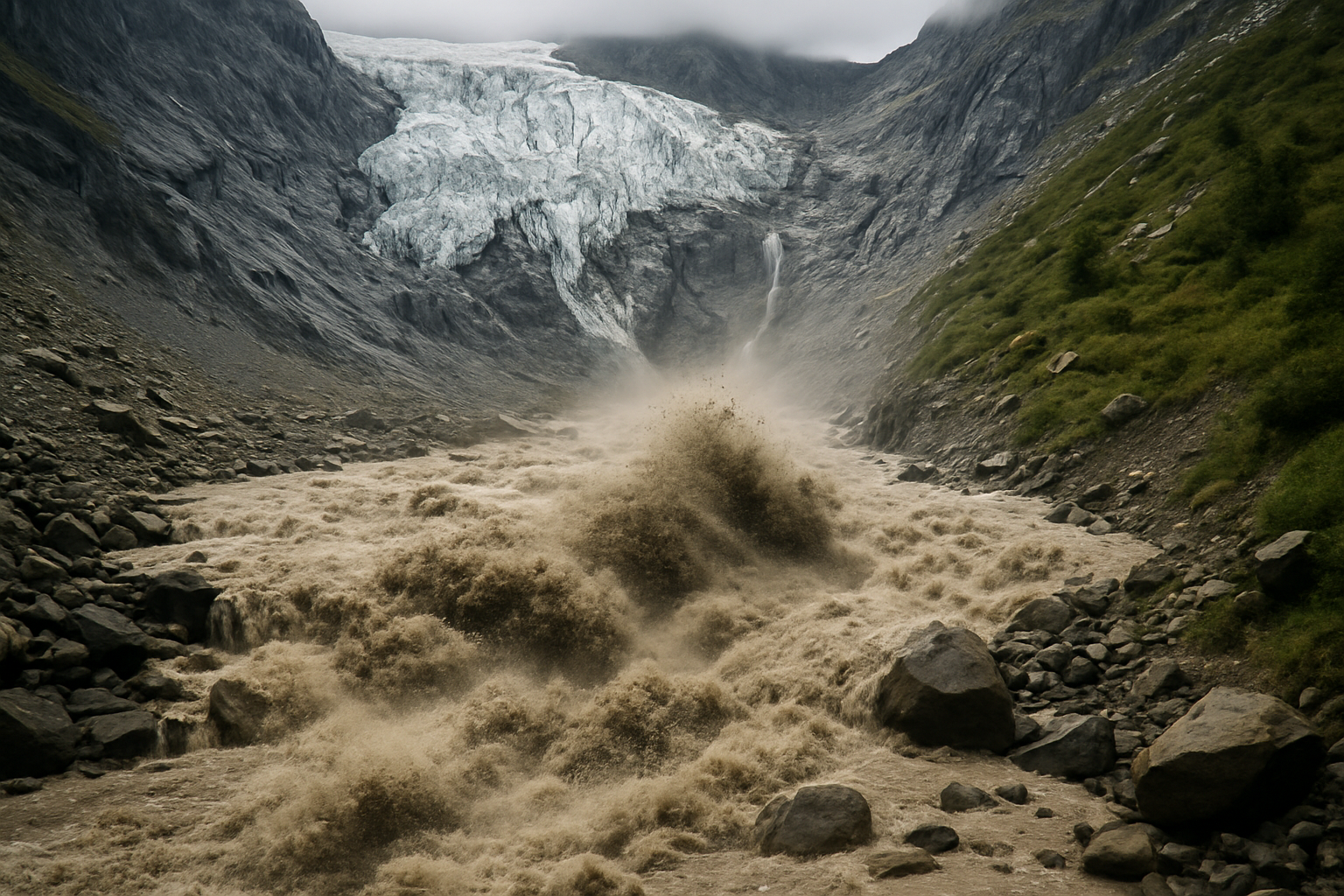
Preliminary scientific investigations indicate that the deadly flash floods on the Nepal-Tibet border were likely triggered by the collapse of part of a glacier, rather than by an earthquake-induced landslide as initially reported.
At least 177 people have been killed in the disaster. Early reports of an earthquake led to suggestions that a tremor had caused a landslide, setting off the flooding. The US Geological Survey later said the event was caused by a glacial collapse, in which a glacier or part of one breaks apart.
Data reviewed by the US Geological Survey and other scientists indicated that the impact of the collapsing glacier at the base of a valley registered at magnitude 5.2.
Dr Simon Cook, a glacier specialist at the University of Dundee, said his team identified a collapse in the lower section of a glacier near Nepal’s Langtang Lirung peak, about 15km west of the flood site. He estimated that the glacier moved northwest before travelling west downstream.
Surge in river levels
An assessment by the International Centre for Integrated Mountain Development (ICIMOD) said the event may have involved an ice-rock avalanche from a high-altitude area. It said ice and rock debris entered the Lende Khola, a tributary of the Bhote Koshi river, producing a sudden downstream surge carrying water, sediment and large boulders.
According to ICIMOD, water levels in downstream rivers rose by between seven and nine metres in 30 minutes. Several water-monitoring stations were washed away or damaged. The affected area is bordered by steep mountains, with footage showing water and debris rapidly channelled through the valley.
The immediate reason for the glacier’s collapse on Wednesday remains unclear. However, scientists have long warned that warming temperatures are melting Himalayan ice and thawing permafrost, potentially increasing the instability of high mountain landscapes.
ICIMOD said in an analysis published earlier this year that glaciers in the Hindu Kush Himalaya are losing ice at twice the rate seen before 2000. Mohd Farooq Azam, a specialist at the organisation, said hazards involving the Earth’s frozen regions were becoming increasingly visible and that the pace of change was challenging existing responses.
Dr Cook said it was difficult to link an individual event directly to climate change, but said the broader pattern was consistent with risks associated with shrinking glaciers, snowmelt and degrading permafrost. Similar glacier-collapse-related floods and landslides have occurred in recent years in India, Switzerland and Italy, he said.
Source: BBC News
