

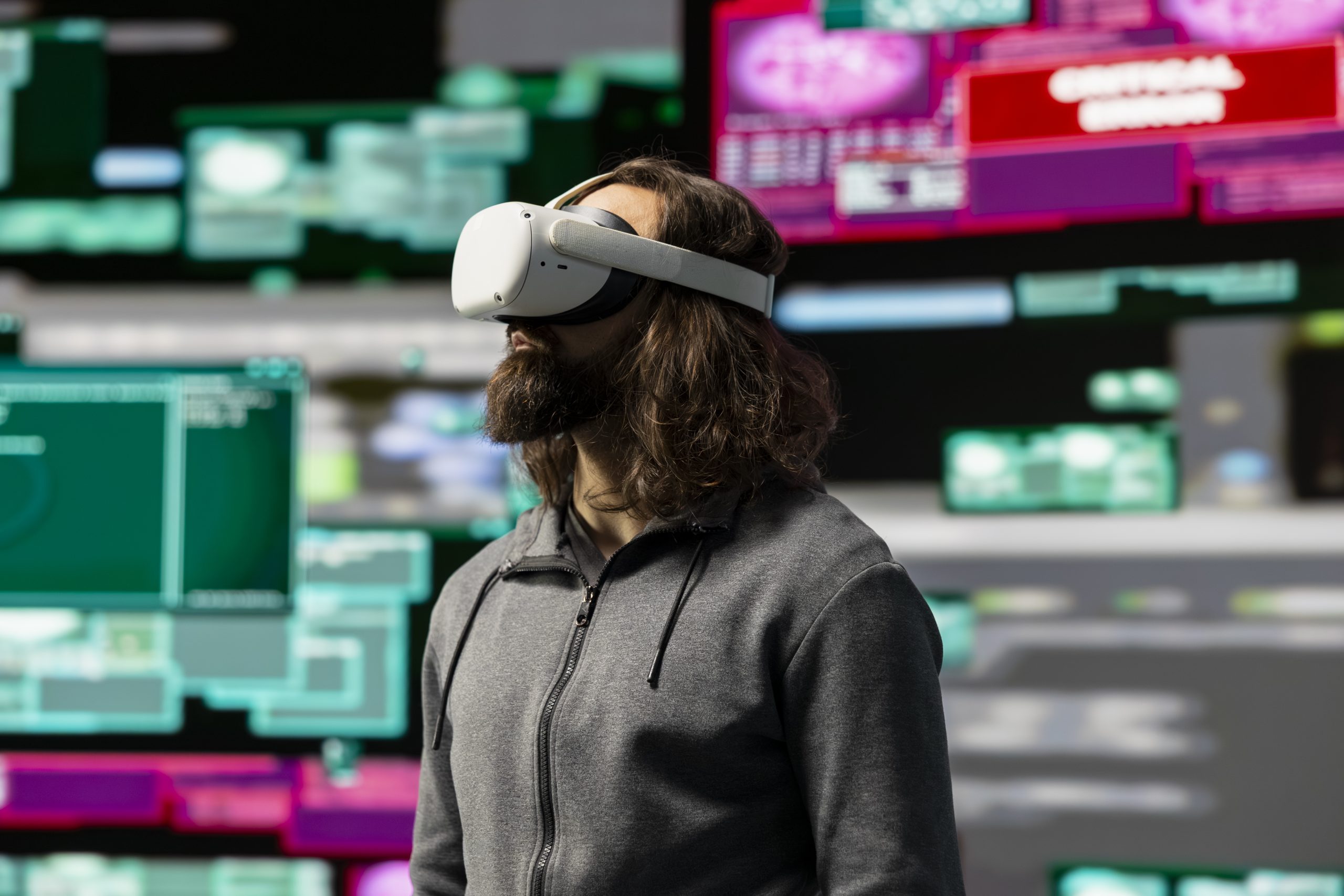
A wave of emerging technologies — from immersive digital environments to edge computing and biological–digital interfaces — is driving the next phase of global transformation. Analysts say these breakthroughs could fundamentally change how people interact with technology, how cities function, and how industries operate.
Immersive Technology Moves Beyond Entertainment
Virtual and augmented reality systems are rapidly expanding into education, medicine, engineering, and public communication. Research groups collaborating with the Carnegie Mellon University have demonstrated new mixed-reality platforms capable of simulating complex environments for training surgeons, disaster responders, and pilots.
Businesses are investing in virtual workspaces that replicate real-world collaboration, while museums and cultural institutions explore immersive storytelling to engage global audiences.
Edge Computing Brings Power Closer to the User
While cloud computing remains central to digital infrastructure, edge computing is increasingly critical for real-time applications. As industries adopt autonomous vehicles, robotics, and remote medical diagnostics, processing data closer to the point of use has become essential.
Engineers affiliated with the Institute of Electrical and Electronics Engineers say edge networks could reduce latency, improve security, and enable faster decision-making across logistics, manufacturing, and smart-city systems.
Bio-Digital Interfaces Emerge as a New Frontier
The convergence of biology and computing is unlocking unprecedented possibilities. Research teams working with the European Molecular Genetics Centre are exploring neural interfaces, synthetic tissues embedded with sensors, and bioelectronic medicines that communicate directly with cells.
Early prototypes suggest that future medical devices may integrate seamlessly with the human body, enabling personalized therapeutic systems and new forms of human–machine interaction.
AI Transparency Becomes a Global Priority
As artificial intelligence becomes deeply embedded in public and private systems, governments and civil-society groups are demanding greater transparency. Digital-rights organizations working with the Electronic Frontier Foundation warn that opaque algorithms could shape behavior, influence elections, and reinforce inequality.
Global regulators are developing standards for explainable AI — systems that can clearly articulate how decisions are made — but implementation varies widely across regions.
Green Computing Reduces the Tech Carbon Footprint
Data centers and large-scale computing systems contribute significantly to global emissions. In response, companies and research institutions are experimenting with energy-efficient chips, liquid cooling, and AI-directed resource management.
Several technology firms are testing renewable-powered server farms and low-energy processors designed to cut power consumption without sacrificing performance. Environmental analysts say green computing is becoming a competitive advantage in global markets.
Cybersecurity Risks Intensify
The expansion of connected devices, advanced sensors, and autonomous systems has created vast new vulnerabilities. Analysts collaborating with the CyberPeace Institute report rising cyberattacks targeting critical infrastructure, healthcare systems, and global supply chains.
Governments are investing in quantum-resistant encryption, biometric verification systems, and international cyber-cooperation frameworks — yet experts warn that protection efforts remain outpaced by emerging threats.
A Technological Turning Point
Researchers say the next decade will be defined not by any single breakthrough, but by the convergence of dozens of rapidly evolving technologies. The challenge for governments, businesses, and communities will be ensuring that innovation benefits everyone — not just those with access to advanced digital tools.
As societies prepare for this new technological era, experts emphasize a central question: how can humanity shape technology’s direction before it shapes humanity?
