

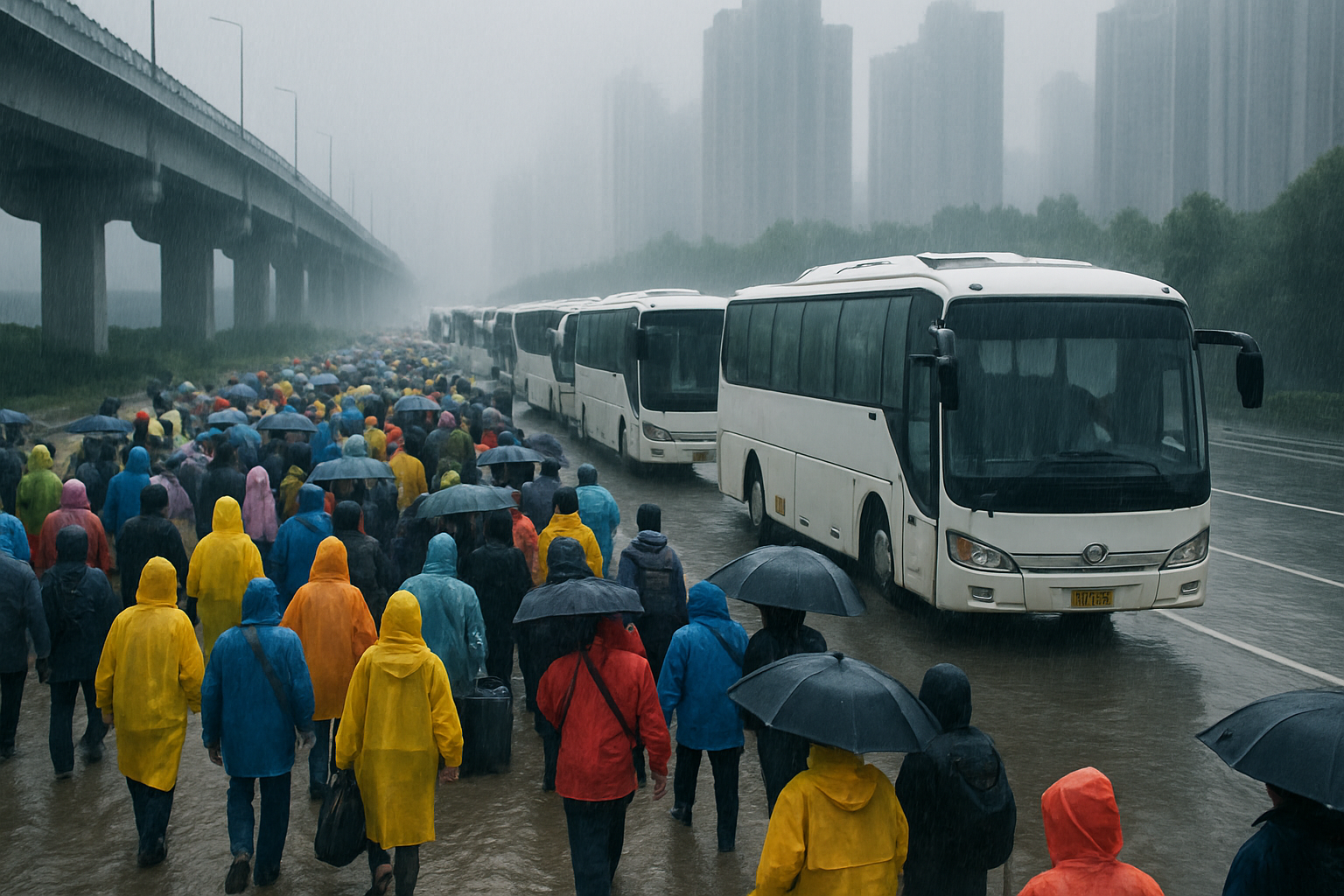
More than one million people have been moved from their homes in eastern China as Typhoon Dolphin made landfall and brought heavy rain, strong winds and widespread transport disruption, including in Shanghai.
Chinese authorities had issued their highest-level red alert before the storm arrived, describing Dolphin as the strongest to affect China this year. The typhoon first came ashore in Yuhuan, Zhejiang province, at about 17:30 local time on Sunday, with maximum winds of 150km/h, according to meteorological authorities. It made a second landfall in Wenzhou roughly an hour later.
The system has since been downgraded to a tropical storm, but officials continue to warn of torrential rainfall, serious flooding and possible landslides as it moves north through Wednesday. Heavy rain was forecast for Shanghai and the provinces of Shandong, Henan, Hubei, Anhui, Jiangsu and Zhejiang.
Flooding and disruption
Nearly 1,000 flights were cancelled in Shanghai on Monday, while authorities urged residents to avoid outdoor activities. Parts of Disneyland and Legoland were closed, along with several viewing platforms on Shanghai’s Bund waterfront.
State media footage showed flooding affecting ground-floor businesses in Shanghai’s former French Concession, with people walking through ankle-deep water. Forecasters said areas of Zhejiang could receive between 250mm and 500mm of rain in the coming days.
In Wenzhou, authorities relocated about 900,000 residents and opened more than 1,000 emergency shelters. Around 390,000 people were evacuated in Taizhou. Hangzhou officials waived parking charges in public spaces for motorists seeking protection from the winds and floodwaters.
In neighbouring Fujian province, maritime authorities suspended dozens of passenger ferry services and stopped more than 100 offshore construction projects.
Casualties and regional impact
Officials had not reported any fatalities in China. However, state media said a nine-year-old boy was missing in Wenling, Zhejiang, after reportedly being swept into the sea.
China’s state broadcaster CCTV said Dolphin travelled about 6,000km before reaching land and had an unusually long lifespan, large circulation and capacity for intense rainfall.
Before reaching China, the storm brought heavy rain to the Philippines, northern Taiwan and Japan’s Okinawa island. The Philippines’ Office of Civil Defence said eight people had died in heavy monsoon rain associated with Dolphin and earlier storms, while more than 7,000 people were sheltering at evacuation centres. Okinawa authorities reported five elderly people sustained non-life-threatening injuries, including three people who fell in strong winds.
Authorities also acted against what state media described as storm-related misinformation online, detaining two people over allegedly misleading material, including an AI-generated video and re-edited footage.
Source: BBC News
