

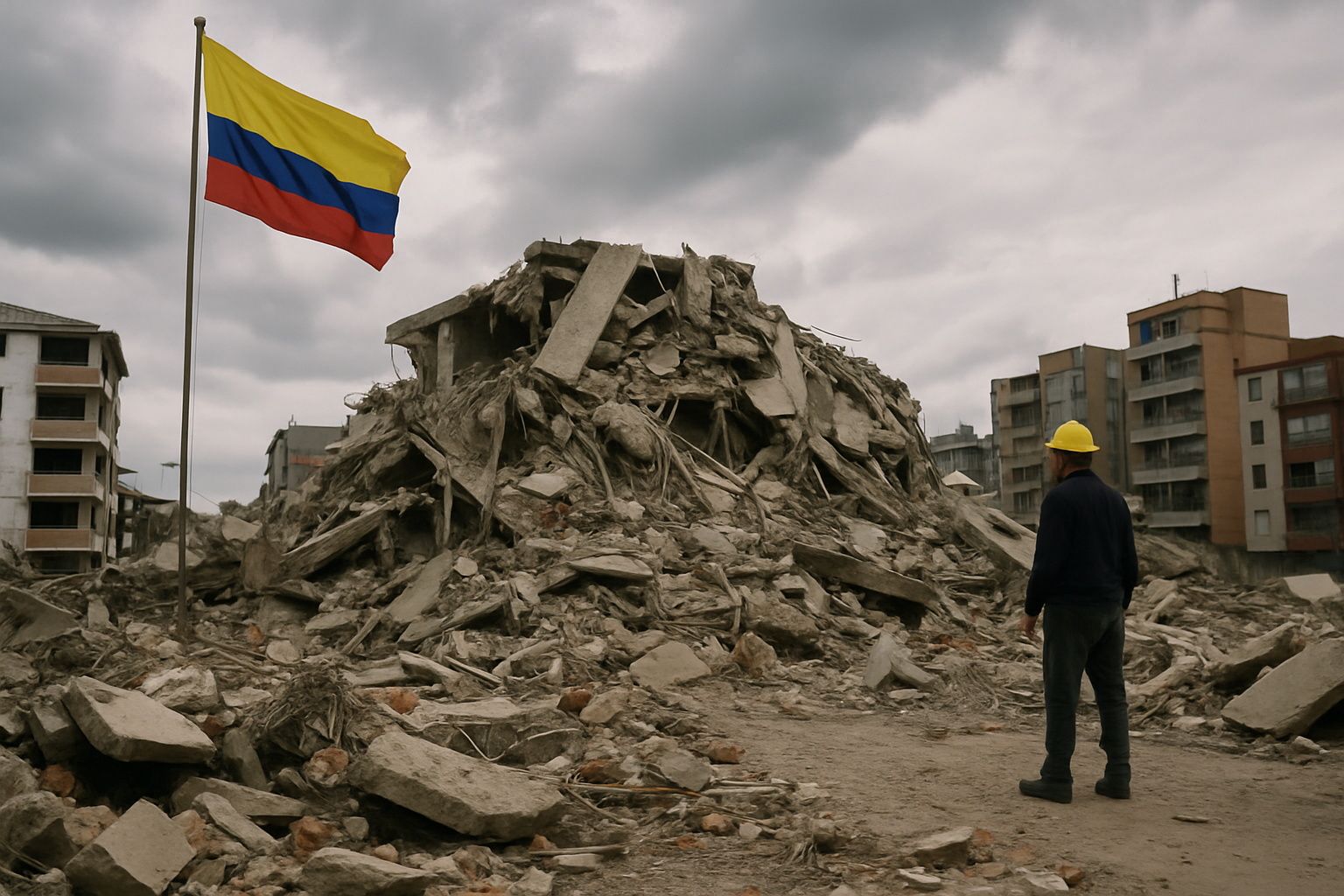
At least 132 people have been killed after a powerful earthquake struck western Colombia, prompting the government to declare a national disaster situation as rescue teams search damaged areas.
Colombia’s geological service said the magnitude 7.4 earthquake hit Chocó province at 07:34 local time, at a depth of 103km. The epicentre was near the village of San José del Palmar, and the shaking was felt across hundreds of miles of western Colombia as well as in neighbouring Venezuela, Ecuador and Panama.
More than 480 people were injured, according to Colombia’s Association of Capital Cities. Authorities fear the death toll may increase because people are believed to remain trapped beneath collapsed buildings.
Damage concentrated in Pereira and Cali
Pereira, about 55km from the epicentre, was among the worst-hit cities. Local authorities reported at least 40 deaths in its metropolitan area, where 65 buildings collapsed. People were believed to be trapped in 15 of those structures, and a curfew was imposed in parts of the city until 05:00 local time on Tuesday.
Verified video showed a building collapse in Plaza Bolívar, Pereira’s main square, leaving debris and dust across the open area. In Cali, around 160km south of Pereira, authorities reported that 32 buildings had collapsed.
Deaths were also reported in Manizales, Quibdó, Medellín and across the Chocó and Valle del Cauca regions. At least two people died in Manizales, where residents reported cracking walls, falling bricks and dust from nearby buildings.
San José del Palmar’s mayor, León Fabio Marín Moncada, said there had been no reported deaths or injuries in the village nearest the epicentre, although roads leading into and out of the area were damaged.
Emergency response underway
President Abelardo de la Espriella said more than 1,500 homes had been damaged. The emergency declaration gives the government special authority to respond, including the ability to reallocate budgets.
Colombia’s aviation authority reported damage at regional airports in Pereira, Manizales, Quibdó, Armenia, Cartago and Buenaventura. In Bogotá, trees and traffic lights shook violently, while cracks were reported in buildings, though no serious damage to the capital’s infrastructure had been reported.
The United States said it was monitoring the situation and was ready to provide support. European Commission President Ursula von der Leyen said the EU’s Copernicus satellite system was being used in the rescue operation, while El Salvador’s President Nayib Bukele offered personnel and equipment.
Source: BBC News
