

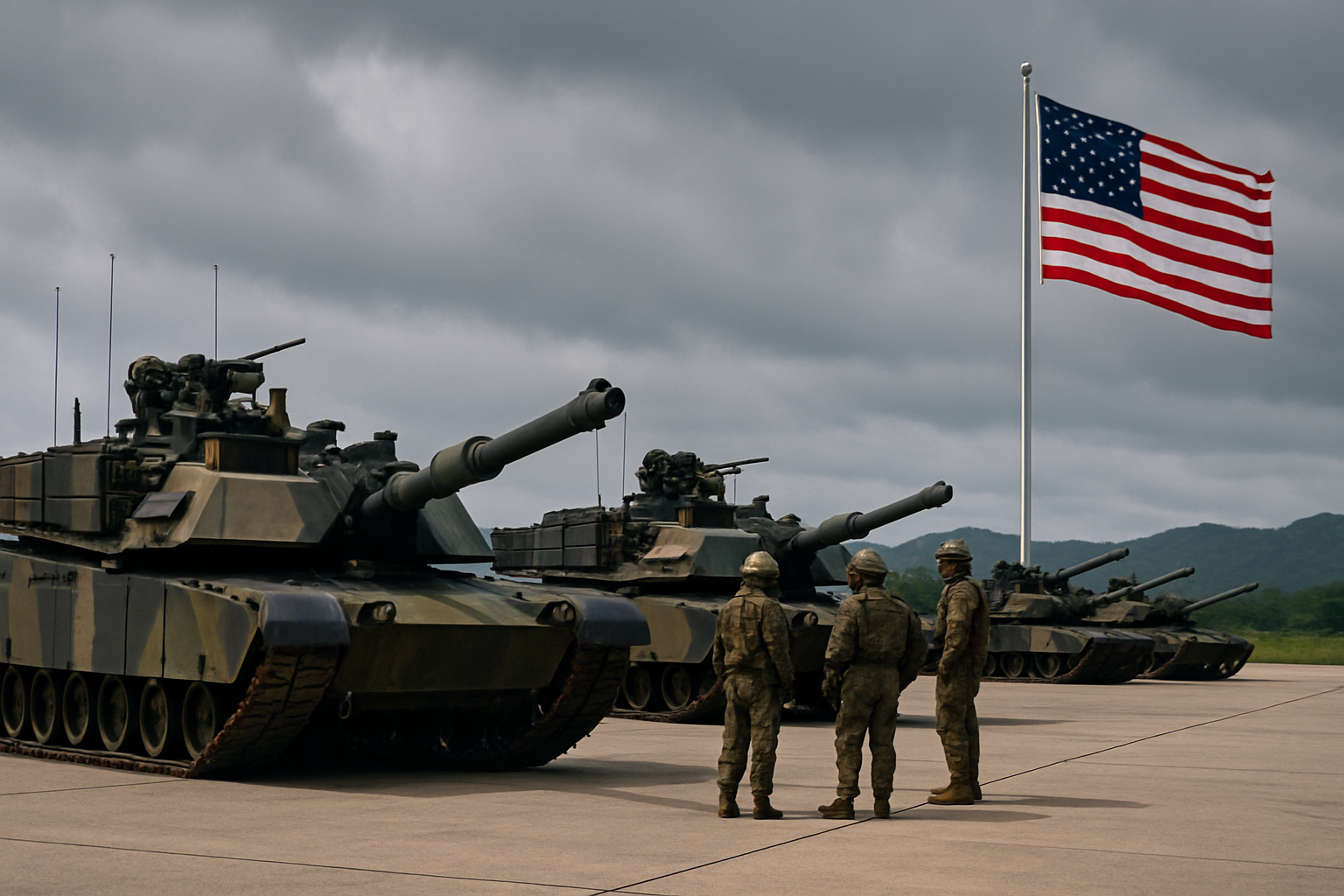
President Donald Trump has said the United States will “substantially reduce” its joint military exercises with South Korea, pointing to his relationship with North Korean leader Kim Jong Un and Seoul’s decision not to join US efforts involving Iran.
In a Truth Social post on Sunday, Trump said the exercises were expensive and argued that they sent an unnecessarily hostile signal. He said the United States pays much of the cost of the drills and described his relationship with Kim as “very good.”
Trump said it was too late to cancel the annual exercises, which were due to begin on Monday. The announcement followed his recent request that South Korea take part in what he called the “denuclearisation” of Iran. According to Trump, South Korean President Lee Jae Myung declined the request.
Seoul reviewing comments
South Korea’s presidential Blue House said it was reviewing Trump’s remarks. It added that it hoped favourable relations between Washington and Pyongyang could help produce meaningful talks. North Korea had not commented on Trump’s announcement.
Earlier, Seoul had said the joint exercises would proceed as planned. The Blue House said South Korea would continue consultations with Washington on military cooperation related to the Strait of Hormuz, while also discussing the details of the planned drills.
US and South Korean military leaders said last week that the 11-day Ulchi Freedom Shield exercise would be broadly similar in size to previous years, with about 18,000 South Korean soldiers expected to participate. About 28,500 US military personnel are stationed in South Korea.
The planned exercises come after North Korea carried out ballistic missile tests this month that are prohibited by the United Nations. South Korea, the United States and Japan detected the second such test in a matter of days. North Korea’s foreign ministry on Friday called the drills preparation for an aggressive war.
Questions over deterrence
Leif-Eric Easley, a professor at Ewha University in Seoul, said combined exercises are important for ensuring forces are prepared to carry out their roles. He said reducing them could harm alliance coordination, delay South Korea’s assumption of greater responsibility for its defence and weaken deterrence in Asia.
Easley said the financial savings from smaller drills would be limited, while any diplomatic gains with North Korea were uncertain. North Korea has expanded its nuclear and missile programmes since Kim’s high-profile diplomacy with Trump collapsed in 2019.
Trump previously suspended the exercises in 2018 during denuclearisation negotiations with Kim, saying at the time that the drills were provocative and costly. They were scaled back again in 2020 during the Covid-19 pandemic. Trump has repeatedly criticised the US cost of defending South Korea and questioned what Washington receives in return.
Source: BBC News
